
“The trader who understands AI will not replace the trader who uses AI. Both will replace the one who uses neither.”
“Markets move on data. AI processes more data in one second than a human can in a lifetime.”
“AI does not remove the risk from trading. It helps you understand it better.”
Welcome to DSM Tips — honest, practical content on technology, AI, and digital life. Today we are covering a topic that is reshaping one of the world’s oldest industries.
AI is changing how the stock market works — and it is doing it fast.
From retail investors using AI-powered apps to hedge funds running fully automated trading systems, artificial intelligence is now a central part of how money moves in financial markets. Here is what is actually happening and what it means for anyone who invests or trades.
What Is AI Trading?
AI trading means using artificial intelligence and machine learning to analyze financial markets and support trading decisions.
AI systems can track thousands of stocks simultaneously, analyze market trends in real time, study financial news as it breaks, detect trading opportunities before most humans notice them, manage risk automatically, and execute trades based on predefined strategies — all without stopping.
The core advantage is speed and scale. No human analyst can process the volume of data that AI handles in seconds.
How AI Reads the Market
AI does not just look at stock prices. It pulls together multiple layers of information to build a complete picture of market conditions.
Historical Data — Past price movements and trading patterns give AI a foundation for recognizing what similar conditions led to before.
Financial Reports — Company earnings, revenue growth, debt levels, and profit margins are analyzed automatically as they are released.
Market News — AI scans breaking news and assesses its likely impact on specific stocks or sectors within seconds of publication.
Economic Indicators — Inflation rates, interest rate decisions, GDP figures, and employment data are factored into analysis continuously.
Investor Sentiment — Social media discussions, analyst opinions, and market commentary are monitored to gauge crowd psychology.
By combining all of this simultaneously, AI builds a picture of market conditions that would take a human analyst days to assemble manually.
Benefits of AI in Trading
Faster Analysis
AI evaluates thousands of stocks in the time it takes a human to look at one. That speed matters in markets where opportunities open and close in seconds.
Emotion-Free Decisions
Fear and greed are responsible for most trading mistakes. AI does not experience either. It makes decisions based on data alone — consistently, without hesitation, and without the panic that can lead human traders to sell at exactly the wrong moment.
24/7 Market Monitoring
Markets around the world run at different hours. AI monitors all of them continuously, reacting to overnight news or international market movements before a human trader even wakes up.
Pattern Recognition
AI detects patterns in price movements and trading behavior that are invisible to the human eye. These patterns help identify potential entry and exit points with more precision than manual chart analysis.
Risk Management
AI tools help traders set stop-loss levels, manage portfolio exposure, avoid over-concentration in any single position, and diversify across assets automatically — all of which are essential habits for sustainable trading.
How AI Is Used in Trading Right Now
Stock Screening — AI filters thousands of stocks down to a short list based on specific financial or technical criteria in seconds.
Trading Signals — AI generates buy and sell signals based on real-time market conditions and historical pattern matching.
Portfolio Management — AI balances risk and return across a portfolio automatically, adjusting positions as market conditions shift.
News Analysis — AI reads and interprets financial news as it breaks, flagging items most likely to affect specific stocks or sectors.
Market Forecasting — AI models analyze current conditions to generate probability-weighted views of where markets may head next.
AI Trading Bots
Trading bots are automated systems that execute trades based on rules set by the trader or defined by the AI system itself.
The advantages are real — faster execution than any human, no emotional interference, continuous monitoring, and the ability to run multiple strategies simultaneously.
But trading bots are not magic. They require careful setup, regular supervision, and realistic expectations. A poorly configured bot can lose money as quickly as it makes it. And in unusual market conditions, automated systems can behave in unexpected ways.
The tool is powerful. How you use it determines the outcome.
Can AI Predict the Stock Market?
This is the question everyone wants answered — and it deserves an honest response.
AI improves prediction accuracy. It does not guarantee correct predictions.
Financial markets are driven by human behavior, geopolitical events, policy decisions, natural disasters, and countless other variables that no model can fully anticipate. AI can identify probabilities and likely patterns. It cannot see the future.
Anyone claiming that an AI system can consistently predict market movements with certainty is either wrong or selling something. The value of AI in trading is in improving the quality of decisions — not in eliminating uncertainty.
Risks Worth Understanding
Market Uncertainty — Unexpected events move markets instantly and unpredictably. AI models trained on historical data may not handle genuinely novel situations well.
Over-Reliance on Technology — Treating AI output as infallible is a dangerous mistake. AI is a tool that informs decisions, not one that makes them for you.
Data Quality — AI output is only as good as the data it is trained on. Poor or biased data leads to poor and biased outputs.
Technical Failures — Systems crash, connections drop, and software has bugs. Automated trading systems can cause significant losses when technical problems occur at the wrong moment.
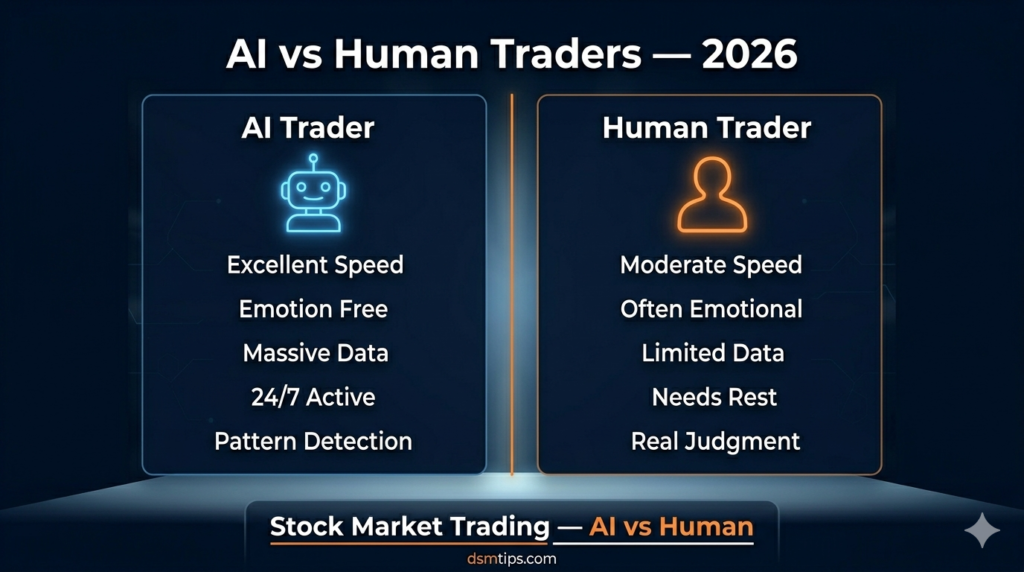
AI vs Human Traders
| Area | AI | Human |
|---|---|---|
| Speed | Excellent | Moderate |
| Emotional Control | Excellent | Often Poor |
| Data Analysis | Massive Scale | Limited |
| Creativity and Judgment | Limited | Strong |
| Adapting to New Events | Slow | Fast |
| Market Experience | Data-Based | Real-World |
The best trading approach in 2026 combines both. AI handles the data-heavy, speed-dependent work. Humans provide context, judgment, and the adaptability to handle situations the data has never seen before.
The Future of AI in Trading
The direction is clear. Trading will become increasingly AI-assisted across every level of the market.
Smarter algorithms that adapt in real time. Advanced prediction systems that incorporate wider data sources. AI-powered investment advisors accessible to retail investors, not just institutions. Personalized trading recommendations based on individual risk tolerance and financial goals. Automated portfolio management that requires minimal human involvement for routine decisions.
The gap between institutions using advanced AI and retail investors not using it at all is already significant. It will widen further unless individual investors start engaging with these tools seriously.
For Anyone Starting Out
Learn the basics first. AI tools are most useful to people who already understand what they are doing. Understand how stocks work, what risk management means, and how markets behave before adding AI to the equation.
Use AI as support, not as a replacement for judgment. The decision to invest is always yours. AI helps you make that decision with better information.
Manage risk seriously. Never invest money you cannot afford to lose. AI does not change that rule.
Keep learning. Markets evolve constantly. The tools and strategies that work today may not work the same way in two years.
Final Thoughts
AI is genuinely transforming stock market trading — making analysis faster, decisions better-informed, and risk management more systematic. But it is not a shortcut to profits and it is not a substitute for understanding what you are doing.
The investors who will benefit most from AI are the ones who treat it as a powerful tool in a broader strategy — not as an oracle that removes the need for their own judgment.
Use it well. Understand its limits. And keep learning.
About the Author
Deepak Munje 📞 9175363333 🌐 dsmtips.com 💻 computerventures.in 📸 Instagram: @deepakmunje4333 | @ai_deepak4333
Connect With Us
🌐 Main Blog: dsmtips.com 💻 Also visit: computerventures.in 📸 Instagram: @deepakmunje4333 | @ai_deepak4333 📞 Contact: 9175363333
🎉 Welcome to DSM Tips!
Whether you are a beginner investor, an experienced trader, or just someone curious about where finance and technology meet — you are in exactly the right place.
At DSM Tips, we keep things honest, simple, and genuinely useful. No hype. No false promises. Just content that helps you make better decisions.
Welcome to the DSM Tips family. Really glad you are here.
Keep learning. Keep growing.
— Team DSM Tips
© DSM Tips | dsmtips.com | Also visit: computerventures.in | Contact: 9175363333