
“We are not preparing for a world where AI exists. We are preparing for a world where AI is everywhere.”
“The people who understand what AI is becoming will shape the future. Everyone else will simply live in it.”
“2030 is closer than it feels. And AI is moving faster than most people realize.”
Welcome to DSM Tips — your go-to place for honest, practical insights on technology, AI, and digital life. Today we are looking ahead — past the headlines and hype — at what Artificial Intelligence is genuinely expected to look like by 2030.
This is not speculation for the sake of it. Understanding where AI is heading helps you make smarter decisions about your career, your business, and the skills worth developing right now.
Let’s get into it.
AI Is Moving Faster Than History Has Ever Seen
A decade ago, voice assistants were novelties that could barely understand an accent. Five years ago, generative AI was a niche research topic. Today, AI writes, designs, codes, diagnoses, drives, and recommends — and it is getting significantly better every year.
By 2030, experts broadly agree on one thing: AI will not be a separate technology you choose to engage with. It will be woven into the fabric of nearly every industry, every workplace, and every aspect of daily life.
The question is not whether this will happen. The question is whether you will be ready for it.
How AI Will Transform Major Industries by 2030
Healthcare
The healthcare transformation already underway will accelerate dramatically. AI systems will assist doctors in diagnosing diseases earlier and more accurately than current methods allow — catching conditions in medical imaging that human eyes might miss, flagging anomalies in patient data before symptoms appear, and accelerating drug discovery from years to months.
Personalized treatment will become more common. Instead of one-size-fits-all protocols, AI will help design treatment plans based on an individual patient’s genetic profile, history, and real-time health data. Healthcare will become faster, more accurate, and progressively more accessible — particularly in regions where specialist doctors are scarce.
Education
The classroom of 2030 will look fundamentally different. AI tutors will provide truly personalized learning experiences — adapting difficulty in real time, identifying gaps in understanding before exams, and delivering explanations in the style that works best for each individual student.
Language barriers in education will shrink significantly, with AI-powered translation making quality educational content accessible regardless of native language. Instant feedback on assignments, customized study plans, and adaptive curricula will replace the one-size-fits-all approach that has defined formal education for centuries.
Business and Marketing
For businesses, AI will move from being a useful tool to being a central operating system. Customer support, data analysis, marketing campaign optimization, content creation, inventory management, and financial reporting — large portions of all of these will be automated or AI-assisted.
This does not mean businesses will need fewer people. It means the people they need will be focused on strategy, creativity, relationship-building, and the complex judgment calls that AI cannot make. The businesses that figure this out early will operate with significant efficiency advantages over those that do not.
Transportation
Self-driving vehicles are already on the roads in limited deployments. By 2030, the technology will be significantly more mature and widespread. AI traffic management systems will optimize flow across cities in real time, reducing congestion, cutting commute times, and lowering accident rates.
Logistics networks will become dramatically smarter — AI coordinating deliveries, anticipating supply chain disruptions before they occur, and routing vehicles with precision that human dispatchers could never match at scale.
Finance
The financial sector will be one of the most thoroughly AI-transformed industries by 2030. Fraud detection that currently flags suspicious transactions will evolve into systems that identify complex fraud patterns before transactions even complete. Investment analysis will incorporate data sources and variables beyond any human analyst’s capacity to process.
Personalized financial advice — currently accessible only to high-net-worth individuals who can afford dedicated advisors — will become available to anyone with a smartphone. AI will make financial services both safer and more democratically accessible.
AI and the Future of Jobs
This is the question most people care about most — and it deserves an honest answer.
Some jobs will change significantly. Data entry, basic customer support, routine administrative work, and simple content production are already being automated in meaningful ways. By 2030, this trend will continue and deepen.
But the picture is not one of mass unemployment. It is one of transformation. New roles are already emerging — AI specialists, data scientists, AI consultants, automation experts, prompt engineers, AI ethicists, and cybersecurity professionals focused specifically on AI systems.
The workforce of 2030 will not be competing with AI. It will be working alongside it. The professionals who will thrive are the ones who develop both the technical fluency to use AI tools effectively and the human capabilities — creativity, judgment, leadership, empathy — that AI cannot replicate.
Smart Homes and Everyday Life
By 2030, AI will be a background presence in daily life in ways that feel natural rather than intrusive.
Smart home systems will anticipate your needs rather than simply respond to commands. Your home will adjust temperature, lighting, and energy usage based on your patterns and preferences without being told. AI-powered shopping will understand your needs before you articulate them. Entertainment will be genuinely personalized — not just recommendation algorithms, but content adapted to your mood, your history, and your preferences in real time.
The technology will become more intuitive, more responsive, and — when designed well — genuinely useful rather than gimmicky.
The Real Benefits AI Will Deliver by 2030
The case for AI’s positive impact is strong when you look at what it will actually enable:
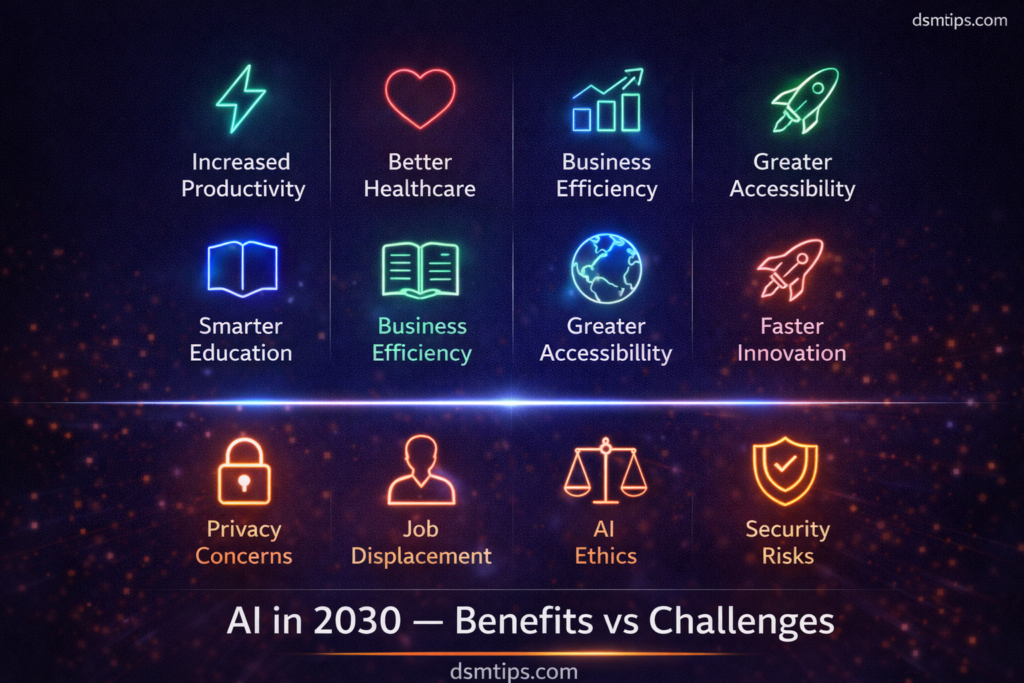
Increased productivity across every knowledge-work profession — more output, better quality, in less time. Healthcare outcomes that improve as diagnostics become more accurate and treatments become more personalized. Education that actually adapts to individual students rather than forcing students to adapt to fixed systems. Business efficiency that frees human workers from repetitive tasks and redirects their energy toward creative and strategic work. Greater accessibility — AI-powered tools bringing services to people in remote areas or with disabilities who currently lack access. Faster innovation as AI accelerates research across science, medicine, engineering, and every other field.
The Challenges That Cannot Be Ignored
Honest engagement with AI’s future requires acknowledging the real risks alongside the benefits.
Privacy is a genuine concern. AI systems require enormous amounts of data to function, and the collection, storage, and use of that data creates real risks for individual privacy that current regulations are still catching up to address.
Job displacement is real, even if the overall employment picture is more nuanced. The transition will not be painless for everyone, and the workers most affected by automation deserve thoughtful policy responses.
AI ethics is not a theoretical debate — it is an urgent practical challenge. Decisions made by AI systems affect real people’s lives, and those systems can carry and amplify the biases present in their training data.
Security becomes more complex as AI becomes more capable. Advanced AI systems represent both powerful defensive tools and attractive targets for sophisticated attacks.
Governments, organizations, and the broader technology community will need serious regulatory frameworks and genuine ethical commitments to navigate these challenges responsibly.
The Skills That Will Matter Most
If you want to be well-positioned for the AI-transformed world of 2030, the investment worth making now is clear:
Technical Skills: AI literacy — understanding how these tools work and how to use them effectively across your field. Data analysis. Digital marketing. Basic automation. You do not need to be an engineer, but you need to be genuinely comfortable with the technology.
Human Skills: Creativity, communication, leadership, critical thinking, and emotional intelligence. These capabilities become more valuable as AI handles more of the routine cognitive work. The professionals who combine strong human skills with genuine AI fluency will be the most sought-after in virtually every industry.
What 2030 Actually Looks Like
Piecing together what experts broadly agree on, the picture of 2030 looks something like this:
AI assistants are standard tools in virtually every professional workplace. Businesses have automated most routine tasks and restructured around the creative and strategic work that remains. Personalized education is the norm rather than the exception. Healthcare diagnostics are significantly more accurate and early detection is dramatically better than today. Human-AI collaboration is the standard operating model across industries, not a novelty reserved for tech companies.
This is not a dystopian future. Nor is it a utopia. It is a transformed world — one that rewards adaptability and preparation over resistance and denial.
Final Thoughts
Artificial Intelligence will be one of the defining technological forces of the next decade. By 2030, it will touch nearly every aspect of how we work, learn, receive healthcare, move around, and live.
The people who approach this transformation with curiosity rather than fear — who invest in understanding AI, developing the skills to work alongside it, and maintaining the human capabilities that it cannot replicate — will find the most opportunity in the world that is coming.
Start now. The gap between those who are ready and those who are not is already widening.
Connect With Us
🌐 Main Blog: dsmtips.com — Tech, AI, and digital insights in simple language
💻 Also visit: computerventures.in — More on computers, tools, and online income
📸 Instagram: @deepakmunje4333 | @ai_deepak4333
📞 Contact: 9175363333
🎉 Welcome to DSM Tips!
Whether you are a student planning ahead, a professional navigating change, or a business owner thinking about the future — you are in exactly the right place.
At DSM Tips, we keep things honest, simple, and genuinely useful. No fear-mongering. No hype. Just clear, practical content that helps you move forward with confidence.
Welcome to the DSM Tips family. Really glad you are here.
Keep learning. Keep adapting. The future rewards the prepared.
— Team DSM Tips
© DSM Tips | dsmtips.com | Also visit: computerventures.in | Contact: 9175363333