
“The investor who uses AI is not smarter than the market. They are just better prepared for it.”
“AI does not replace research. It makes your research dramatically better.”
“In 2026, the best edge an investor can have is knowing how to ask the right questions — to AI and to themselves.”
Welcome to DSM Tips — honest, practical content on technology, AI, and digital life. Today we are covering something that every investor — beginner or experienced — genuinely needs to understand right now.
How do you actually use AI to analyze the share market?
This is not about AI trading bots or automated systems. This is about using AI as a research partner — to study companies, understand industries, read market signals, and make better-informed investment decisions. Here is a complete step-by-step guide.
What Is AI-Based Share Market Analysis?
AI-based share market analysis means using artificial intelligence tools to study stock data, identify trends, analyze company performance, and generate research insights — faster and more comprehensively than any manual process.
AI can analyze stock prices, financial statements, company earnings reports, market news, economic indicators, industry trends, and investor sentiment simultaneously. What would take a human analyst days to compile, AI can summarize in seconds.
Why Use AI for Stock Market Research?
Speed — AI processes information far faster than any human. A research task that takes you three hours can take AI three minutes.
Scale — AI can analyze thousands of data points simultaneously. No human analyst works at that scale.
Organization — AI structures complex information into clear, actionable insights rather than leaving you with a pile of raw data.
Learning — For beginners especially, AI is an exceptional teacher. Ask it to explain any concept and it will break it down simply and clearly.
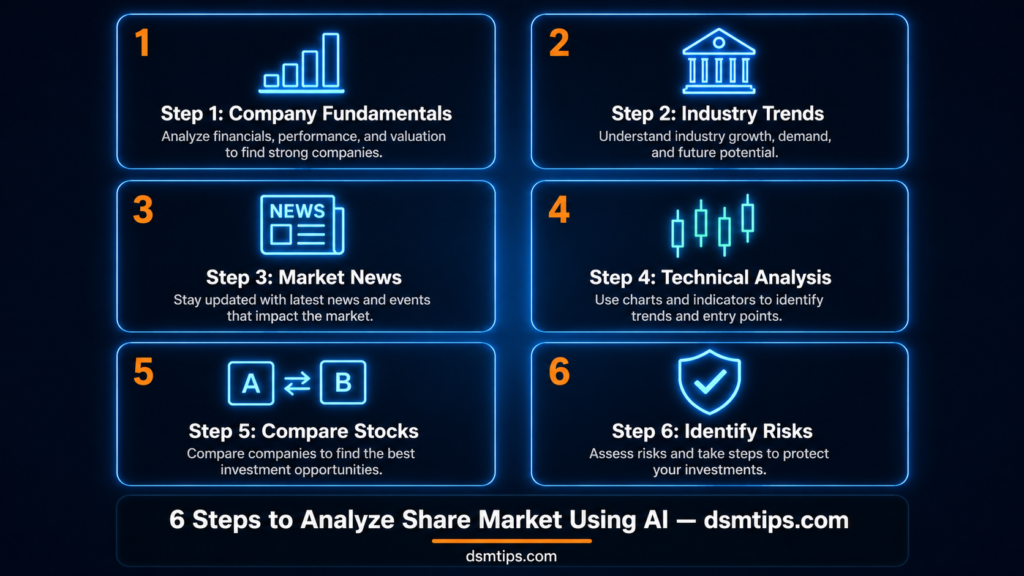
Step 1: Analyze Company Fundamentals
Fundamental analysis is the foundation of good investing. It tells you whether a company is actually financially healthy — regardless of what its stock price is doing on any given day.
Use AI to understand and evaluate:
- Revenue growth — is the company consistently earning more?
- Profit growth — are margins improving over time?
- Earnings Per Share (EPS) — how much profit per share?
- Return on Equity (ROE) — how efficiently is capital being used?
- Debt-to-Equity Ratio — how much does the company owe versus own?
- Cash Flow — is real cash coming in or just accounting profits?
Example prompt to try: “Explain the key financial metrics a beginner investor should check before buying a stock, and what good and bad numbers look like for each.”
AI will walk you through each metric in plain language, making fundamental analysis accessible even if you are just starting out.
Step 2: Study Industry Trends
Even the strongest company in a declining industry faces serious headwinds. Before investing in any stock, understand the direction of the sector it operates in.
Use AI to research growth trends, competitive dynamics, and future outlook across sectors like technology, banking, renewable energy, electric vehicles, healthcare, and artificial intelligence itself.
Example prompt to try: “What are the major growth opportunities and risks in the Indian renewable energy sector over the next five years?”
Understanding the industry context around a stock often matters more than the stock’s individual fundamentals.
Step 3: Analyze Market News
Stock prices react to news — sometimes immediately and dramatically. AI helps you understand what news actually means for specific companies or sectors, rather than just reading headlines.
AI can summarize earnings announcements, explain government policy changes, break down economic reports, clarify interest rate decisions, and flag industry developments that matter for your investments.
Example prompt to try: “Explain how a rise in interest rates by the RBI affects banking stocks, real estate companies, and consumer spending companies differently.”
This kind of multi-angle analysis used to require reading several research reports. AI delivers it in a conversational response.
Step 4: Technical Analysis
Technical analysis looks at price charts and trading patterns to identify potential entry and exit points. AI can explain technical concepts clearly, which makes this area far more accessible to beginners than it used to be.
Key concepts AI can help you understand and apply:
- Support and Resistance levels
- Moving Averages (50-day, 200-day)
- RSI — Relative Strength Index
- MACD — Moving Average Convergence Divergence
- Candlestick patterns
- Trend identification
Example prompt to try: “Explain RSI and moving averages in simple terms. How do traders use them together to identify buying opportunities?”
For actual chart analysis, pair AI with a dedicated charting tool like TradingView which provides professional-grade charts with built-in indicators.
Step 5: Compare Stocks Side by Side
Choosing between two companies in the same sector? AI can create structured, detailed comparisons faster than any manual research process.
Example prompt to try: “Compare Tata Motors and Mahindra & Mahindra from an investor’s perspective — growth potential, profitability, debt levels, and key risks for each.”
AI will produce a clear, organized comparison that highlights the key differences and helps you think through the decision systematically.
Step 6: Identify Investment Risks
Every investment carries risk. Understanding the specific risks attached to a company or sector is just as important as understanding the opportunity.
Use AI to identify high debt levels, competitive threats, regulatory risks, dependence on specific markets or customers, management quality concerns, and macroeconomic vulnerabilities.
Example prompt to try: “What are the main risks an investor should consider before buying shares in an Indian private sector bank?”
Risk analysis done well protects your capital far better than any stock-picking strategy.
Best AI Tools for Share Market Research
ChatGPT — The most versatile tool for research, financial education, company analysis, and learning investment concepts. Start here if you are new to AI-assisted investing.
Google Gemini — Strong for market research, industry trend analysis, and news summarization. Integrates well with Google’s data ecosystem.
TradingView — The standard platform for technical analysis. Professional charts, hundreds of indicators, and a large community of traders sharing ideas.
TrendSpider — Automated chart analysis and AI-assisted trend identification. Particularly useful for traders who want pattern detection without manual chart reading.
Trade Ideas — AI-powered stock screening and real-time trading opportunity identification. More advanced, suited to active traders.
What AI Does Well in Market Analysis
- Processes and summarizes large amounts of financial data quickly
- Explains complex concepts in plain, accessible language
- Creates structured company and sector comparisons
- Identifies questions worth investigating further
- Helps beginners build genuine investment knowledge fast
What AI Cannot Do
Guarantee profits. No AI system can predict the market accurately every time. Anyone claiming otherwise is misleading you.
Replace your judgment. AI is a research tool. The decision to invest your money is always yours, and you should always verify AI output against official sources.
Handle the unpredictable. Markets are moved by events no model anticipates — geopolitical crises, policy surprises, natural disasters. AI works best in conditions that resemble its training data.
Best Practices for Using AI in Your Investing
Always verify important information against official company filings and regulatory disclosures. Read annual reports and financial statements — AI can help you understand them, but read them yourself. Diversify your investments rather than concentrating in a single stock or sector. Focus on long-term learning rather than short-term speculation. Treat AI as your research assistant, not your decision-maker.
Final Thoughts
AI has made serious share market analysis accessible to individual investors in a way it simply was not before. The tools are available, many are free, and the quality of research you can do with them is genuinely impressive.
But good investing still comes down to the same fundamentals it always has — thorough research, honest risk assessment, disciplined decision-making, and continuous learning. AI accelerates and improves that process. It does not replace it.
Start using AI in your research today. Ask better questions. Build better understanding. Make better decisions.
About the Author
Deepak Munje 📞 +91 9175363333 🌐 English Blog: dsmtips.com 💻 Hindi & English Blog: computerventures.in 📸 Instagram: @deepakmunje4333 | @ai_deepak4333 📘 Facebook: deepakmunje4333 🐦 Twitter/X: @DeepakMunje
Connect With Us
🌐 Main Blog: dsmtips.com 💻 Also visit: computerventures.in 📸 Instagram: @deepakmunje4333 | @ai_deepak4333 📞 Contact: 9175363333
🎉 Welcome to DSM Tips!
Whether you are a first-time investor trying to understand the market, or an experienced trader looking to sharpen your research process — you are in exactly the right place.
At DSM Tips, we keep things honest, simple, and genuinely useful. No hype. No false promises. Just content that helps you make better decisions.
Welcome to the DSM Tips family. Really glad you are here.
Keep learning. Keep growing.
— Team DSM Tips
© DSM Tips | dsmtips.com | Also visit: computerventures.in | Contact: 9175363333