
The Smart Investor’s AI Research Companion
Introduction
Every single day, the stock market produces an overwhelming volume of data. Earnings reports. Balance sheets. Industry updates. Economic indicators. Global news. Analyst commentary. For most investors — especially beginners — making sense of all this information before placing a single trade feels nearly impossible.
This is exactly where ChatGPT changes the game.
ChatGPT will not tell you which stock to buy tomorrow, and it cannot predict price movements with certainty. But as a research assistant, it is remarkably powerful. It can help you understand companies faster, decode complex financial statements, compare investment options side by side, and learn concepts that would otherwise take weeks to figure out on your own.
In this guide, you will learn how to use ChatGPT effectively and responsibly for stock market research in 2026.
What Is ChatGPT?
ChatGPT is an AI-powered assistant developed by OpenAI that understands natural language questions and responds with detailed, human-like answers. It can summarize information, explain complex topics, generate structured analyses, and assist with research across virtually any domain.
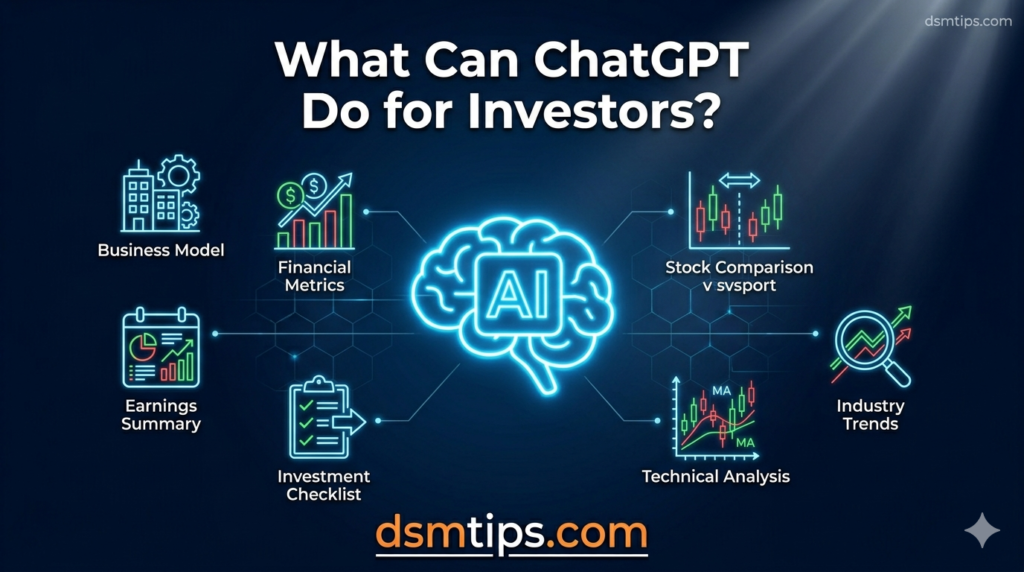
For stock market investors, ChatGPT can specifically help with:
- Understanding a company’s business model and revenue sources
- Breaking down financial metrics and statements
- Comparing two or more stocks side by side
- Learning investment strategies and technical analysis concepts
- Researching industries and emerging market trends
- Summarizing long earnings reports into key takeaways
- Building personal investment checklists
Think of it as having a knowledgeable research partner available 24 hours a day — one that never gets tired and can explain things as simply or as deeply as you need.
Can ChatGPT Predict Stock Prices?
No — and it is important to be clear about this from the start.
No AI system, including ChatGPT, can accurately predict stock prices with consistency. Stock markets are shaped by an enormous range of unpredictable variables including company performance, macroeconomic conditions, government policy changes, global events, and the collective behavior of millions of investors.
ChatGPT is a research and learning tool. It should never be treated as a stock prediction machine or a substitute for your own judgment and risk assessment.
How to Use ChatGPT for Stock Market Research
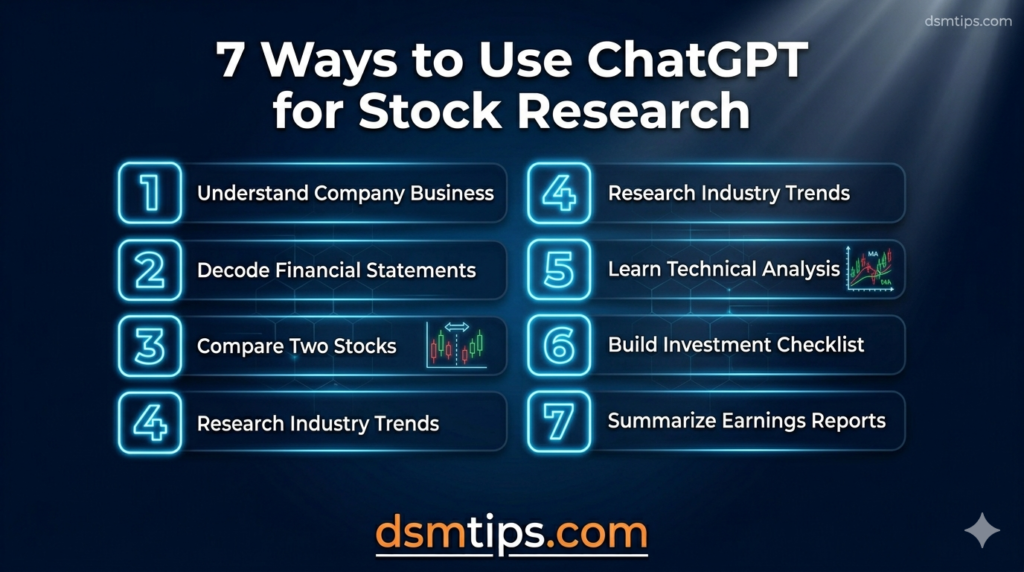
1. Understand a Company’s Business
Before putting money into any stock, you need to understand what the company actually does, how it makes money, and what advantages it has over competitors.
Try this prompt: “Explain Reliance Industries’ business model in simple terms. What are its main revenue sources and competitive advantages?”
ChatGPT will give you a structured overview of the company’s segments, income streams, market position, and strengths — saving you hours of reading through annual reports.
2. Decode Financial Statements
Financial reports are full of terms that can confuse even experienced investors. ChatGPT can translate them into plain language.
Try this prompt: “Explain revenue, profit margin, EPS, debt-to-equity ratio, and ROE in simple language with examples.”
Once you understand the key metrics, you can ask ChatGPT to help you analyze a specific company’s financials and what those numbers actually mean for investors.
3. Compare Two Stocks
Choosing between two companies in the same sector is one of the most common challenges investors face. ChatGPT can create structured, side-by-side comparisons.
Try this prompt: “Compare TCS and Infosys based on business model, revenue growth, profitability, debt levels, and long-term investment potential.”
This gives you a balanced starting point for your own deeper research rather than guessing which company might be the better investment.
4. Research Industry Trends
Stock prices rarely move in isolation. Industry-level trends often have a far bigger impact on a company’s future than its individual performance.
Try this prompt: “What are the major growth opportunities and risks in the Indian renewable energy sector over the next five years?”
ChatGPT can help you identify emerging trends, regulatory tailwinds, competitive dynamics, and potential red flags within any industry you are researching.
5. Learn Technical Analysis
Technical analysis is the study of price charts, patterns, and market indicators to identify potential trading opportunities. For beginners, the terminology can feel overwhelming.
Try this prompt: “Explain support and resistance levels with practical examples. How should a beginner use them?”
ChatGPT can walk you through candlestick patterns, moving averages, RSI, MACD, volume analysis, and trend identification — all explained in language that actually makes sense.
6. Build an Investment Checklist
The best investors are systematic. Having a personal checklist before buying any stock helps eliminate emotional decisions.
Try this prompt: “Create a detailed stock investment checklist for a long-term investor focused on Indian markets.”
Your checklist might cover revenue and profit growth trends, debt levels, competitive moats, management quality, valuation ratios, and sector outlook — giving you a consistent framework every time you evaluate a new stock.
7. Summarize Earnings Reports
Quarterly earnings reports can run to dozens of pages. ChatGPT can compress the most important information into a quick, structured summary.
Try this prompt: “Here is the latest quarterly earnings report of Infosys. Summarize the key highlights, revenue changes, profit performance, guidance updates, and major risks mentioned.”
This alone can save investors hours of reading each earnings season.
Best ChatGPT Prompts for Investors
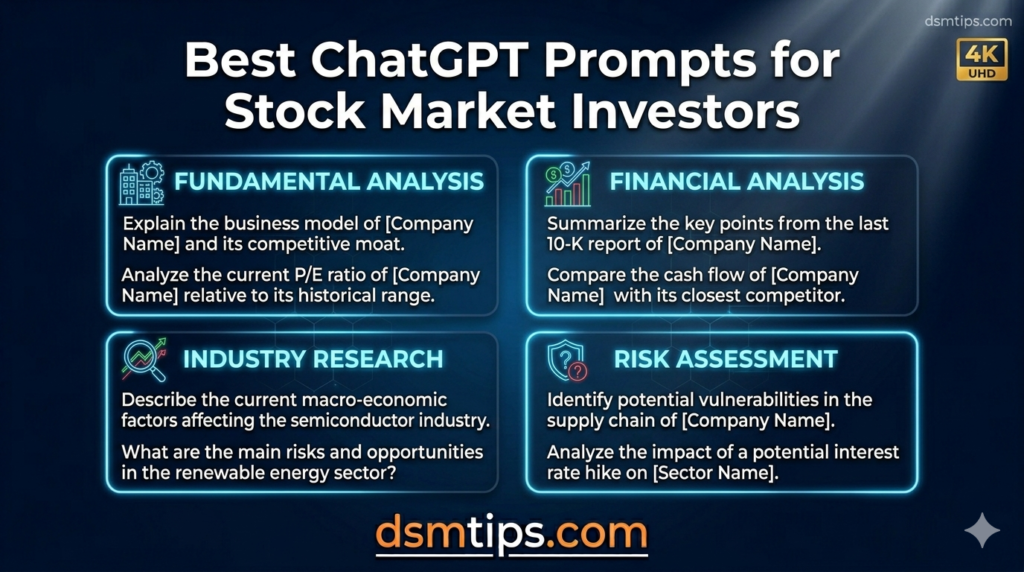
Fundamental Analysis
- “Analyze the key strengths and weaknesses of [Company Name] as an investment.”
- “Explain the business model of [Company Name] and how it generates profit.”
- “What are the competitive advantages of [Company Name] compared to its peers?”
Financial Analysis
- “Explain this balance sheet in simple terms and highlight any concerns.”
- “Analyze this income statement and tell me what the numbers indicate about company health.”
- “What are the key financial risks visible in this company’s recent reports?”
Industry Research
- “Which sectors in India are expected to see the strongest growth over the next five years?”
- “Explain the investment opportunities in the AI, renewable energy, and EV sectors in India.”
Risk Assessment
- “What are the biggest business and market risks facing [Company Name] right now?”
- “How could rising interest rates or a global slowdown impact this stock?”
Advantages of Using ChatGPT for Research
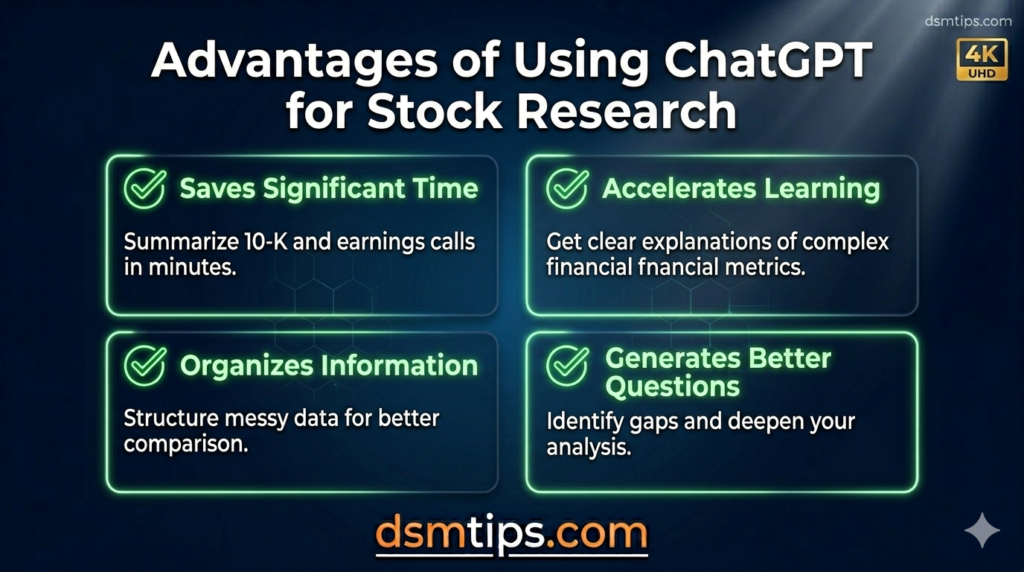
Saves significant time — Get structured summaries and explanations in seconds instead of spending hours across multiple sources.
Accelerates learning — Beginners can understand complex financial concepts faster and more clearly than through traditional reading.
Organizes information — ChatGPT structures research into clean tables, bullet lists, summaries, and checklists that are easy to act on.
Generates better questions — Often the most valuable thing ChatGPT does is help you identify what questions to ask next, leading to deeper and more thorough research.
Limitations of ChatGPT — What Investors Must Know
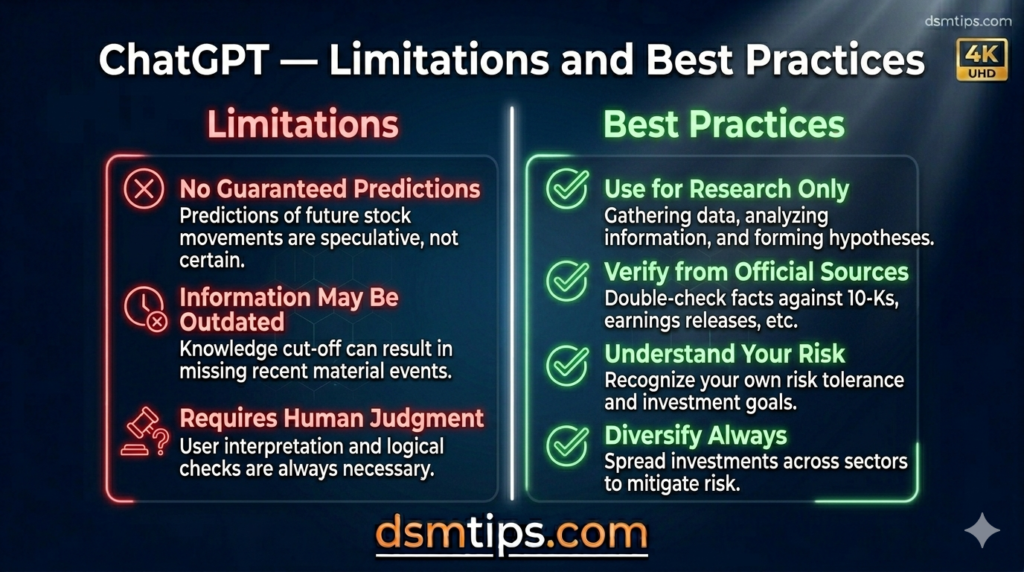
No guaranteed predictions — ChatGPT cannot tell you whether a stock will go up or down. Anyone who tells you otherwise is wrong.
Information may not be current — ChatGPT’s training data has a knowledge cutoff. Always verify important data using official company reports, stock exchange filings, and trusted financial news sources.
Requires your judgment — AI gives you information. Decisions are yours. Never invest based solely on what any AI tool tells you.
Best Practices for Using ChatGPT as an Investor
- Use ChatGPT strictly as a research and learning tool
- Always cross-verify key facts with official annual reports and exchange filings
- Read earnings reports directly — use ChatGPT to help you understand them, not replace them
- Understand your own risk tolerance before making any investment
- Diversify your portfolio across sectors and asset classes
- Focus on long-term learning, not short-term tips
Final Thoughts
ChatGPT is quietly becoming one of the most valuable tools available to individual investors. It democratizes access to the kind of research and analysis that previously required expensive subscriptions, financial advisors, or years of self-study.
But the fundamentals of good investing have not changed. Critical thinking, independent analysis, proper risk management, and patience are still what separate successful investors from the rest.
Use ChatGPT to research faster, learn better, and ask smarter questions. Keep your judgment sharp and your decisions your own.
The investors who combine AI-powered research with sound financial knowledge will have a significant edge in the markets of 2026 and beyond.
Seekhte raho. Banate raho. Tumhari agli breakthrough tumhari soch se kahin zyada paas hai.
— *Team DSM Tips*
Connect With Us
🌐 Main Blog: dsmtips.com 💻 Also visit: computerventures.in 📸 Instagram: @deepakmunje4333 | @ai_deepak4333 📞 Contact: 9175363333
*© DSM Tips | www.dsmtips.com | Also visit: www.computerventures.in | Contact: 9175363333*